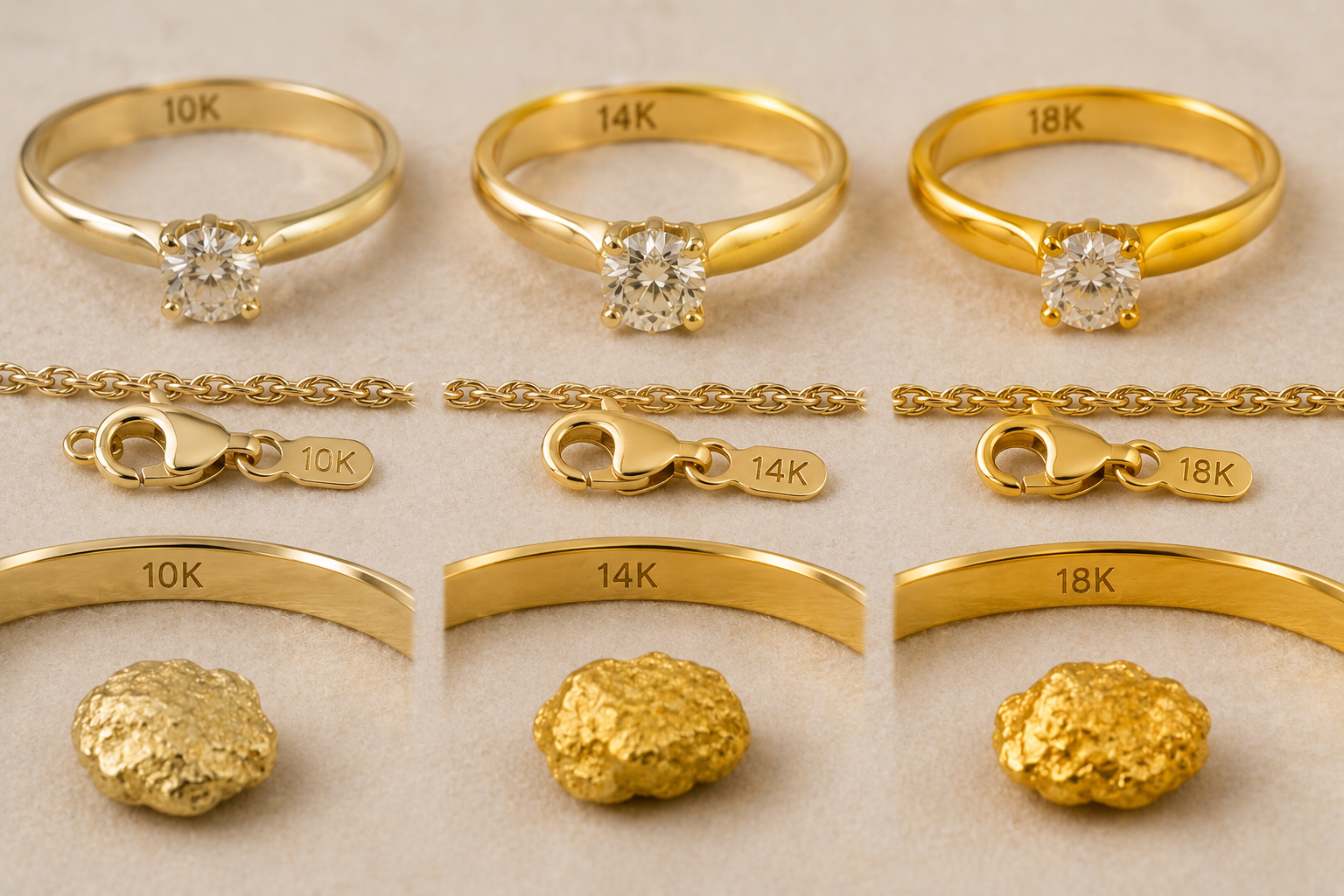
You’ve probably noticed tiny markings like 10K, 14K, or 18K stamped inside a ring, on the clasp of a necklace, or on the back of a piece of jewelry.
Those little numbers can tell you something important: how much gold is actually in the piece. Understanding gold karat marks can make you a more informed shopper and can also help you better understand jewelry you already own.
So, what’s really the difference between 10K, 14K, and 18K gold? Let’s break it down.
What Does “Karat” Mean in Gold Jewelry?
When talking about gold, karat — abbreviated K — measures gold purity. The system divides gold into 24 parts, with 24K representing essentially pure gold.
The Gemological Institute of America (GIA) explains that pure gold is relatively soft, so gold used for everyday jewelry is commonly mixed, or alloyed, with other metals. Those metals can make jewelry more durable and can influence its color.
That gives us the familiar markings:
- 10K gold: 10 parts gold and 14 parts other metals, or about 41.7% gold
- 14K gold: 14 parts gold and 10 parts other metals, or about 58.3% gold
- 18K gold: 18 parts gold and 6 parts other metals, or 75% gold
- 24K gold: essentially pure gold
A higher karat number means a higher proportion of gold. But that doesn’t necessarily mean the highest karat is automatically the best choice for every piece of jewelry.
10K Gold: Less Gold, More Alloy
Of these three common options, 10K contains the lowest percentage of pure gold.
Because a larger portion of the piece consists of other metals, 10K gold can be particularly durable. It can make sense for jewelry that needs to stand up to regular wear.
Its gold color may also appear somewhat less rich than higher-karat yellow gold because of its lower gold content.
For someone shopping with durability and budget in mind, however, 10K can offer a practical balance.
14K Gold: A Popular Middle Ground
There’s a reason you’ll see 14K stamped on so many rings, necklaces, bracelets, and earrings.
At approximately 58.3% gold, 14K sits between the higher gold content of 18K and the greater proportion of alloying metals found in 10K.
GIA identifies 14K as the most popular gold fineness in the United States, making it a familiar choice for everything from everyday jewelry to engagement rings.
For many shoppers, that combination of gold content, durability, appearance, and price makes 14K an appealing middle ground.
18K Gold: More Gold, Richer Color
Move up to 18K, and 75% of the metal is pure gold.
That higher gold content typically gives yellow gold a richer color. GIA notes that metals containing more gold tend to have richer color and be heavier, softer, and more costly.
That softness is worth considering. While 18K jewelry can be beautiful, it may be somewhat more susceptible to scratches or dents than lower-karat alloys.
For jewelry lovers who prioritize a higher gold content and rich appearance, however, 18K can be an attractive choice.
What About Marks Like 417, 585, and 750?
Not every piece of gold jewelry uses a familiar “K” marking.
You may also encounter three-digit numbers such as:
- 417 = approximately 41.7% gold, or 10K
- 585 = approximately 58.5% gold, close to 14K
- 750 = 75% gold, or 18K
These markings express gold purity in parts per thousand, sometimes called fineness. GIA notes, for example, that an 18K piece may be stamped either 18K or 750, depending on where it was made.
So if you open your jewelry box and find “750” instead of “18K,” don’t assume the piece isn’t gold. It may simply use a different system for expressing its gold content.
Does Karat Affect the Value of Your Jewelry?
Yes, but karat is only part of the picture.
All else being equal, a piece with a higher percentage of gold contains more precious metal. But determining what a particular piece is worth can also involve factors such as:
- Weight
- Current gold prices
- Condition
- Brand or maker
- Craftsmanship
- Gemstones
- Design
- Resale demand
This is why two pieces marked 14K aren’t automatically worth the same amount.
A lightweight 14K chain and a heavy 14K bracelet contain different amounts of gold. A signed or highly desirable piece may also have value beyond its precious-metal content.
Yellow, White, or Rose: Is It Still Gold?
Yes. Gold jewelry doesn’t have to look traditionally yellow.
Pure gold has a naturally yellow color. Jewelers can create different appearances by combining gold with other metals.
For example, white gold and rose gold can have the same karat rating as yellow gold. An 18K rose gold ring and an 18K yellow gold ring are both 75% gold; the differences come from the metals used in their alloys.
According to GIA’s guide to yellow, white, and rose gold, those alloying metals affect both the color and physical characteristics of the finished jewelry.
Don’t Confuse Karat With Carat
Here’s an easy jewelry term to mix up. Karat and carat may sound exactly the same, but they measure two completely different things.
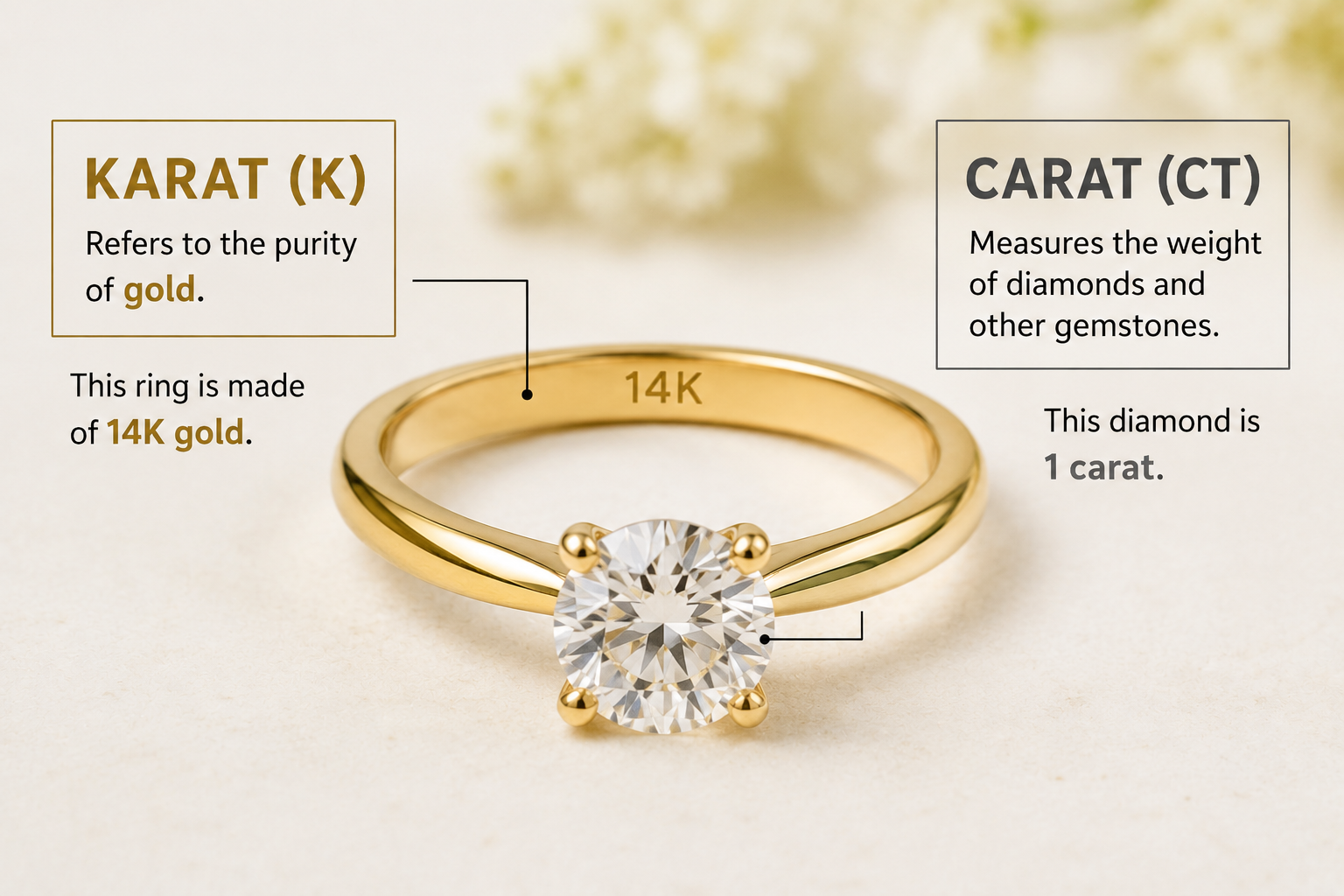
Karat (K) refers to the purity of gold. Since pure gold is 24K, a 14K piece contains 14 parts gold out of 24, while the remaining portion is made up of other metals that can affect the jewelry’s strength, color, and durability.
Carat (ct), on the other hand, measures the weight of diamonds and other gemstones. One carat equals 200 milligrams, but carat weight alone doesn’t determine a gemstone’s quality or value. Cut, color, clarity, and other characteristics can also make a difference.
That means a single piece of jewelry can use both measurements. For example, a ring could be made from 14K gold while holding a 1-carat diamond. The “14K” describes the purity of the gold setting, while “1 carat” describes the weight of the diamond.
An easy way to remember it: karat is for gold purity; carat is for gemstone weight.
Found a Mark on your Gold Jewelry?
Checking the markings on your jewelry is a useful first step toward understanding what you own, but a stamp alone doesn’t tell the entire story.
If you’ve inherited jewelry, discovered an old piece in a drawer, or have gold you simply don’t wear anymore, consider having it evaluated before making assumptions about its value.
At American Jewelry and Loan, our experienced team works with gold and jewelry every day. Whether you’re interested in pawning an item or selling your jewelry for cash, we can take a closer look and help you understand your options.
Have gold jewelry you’re curious about? Bring it to one of our Metro Detroit locations for an evaluation.