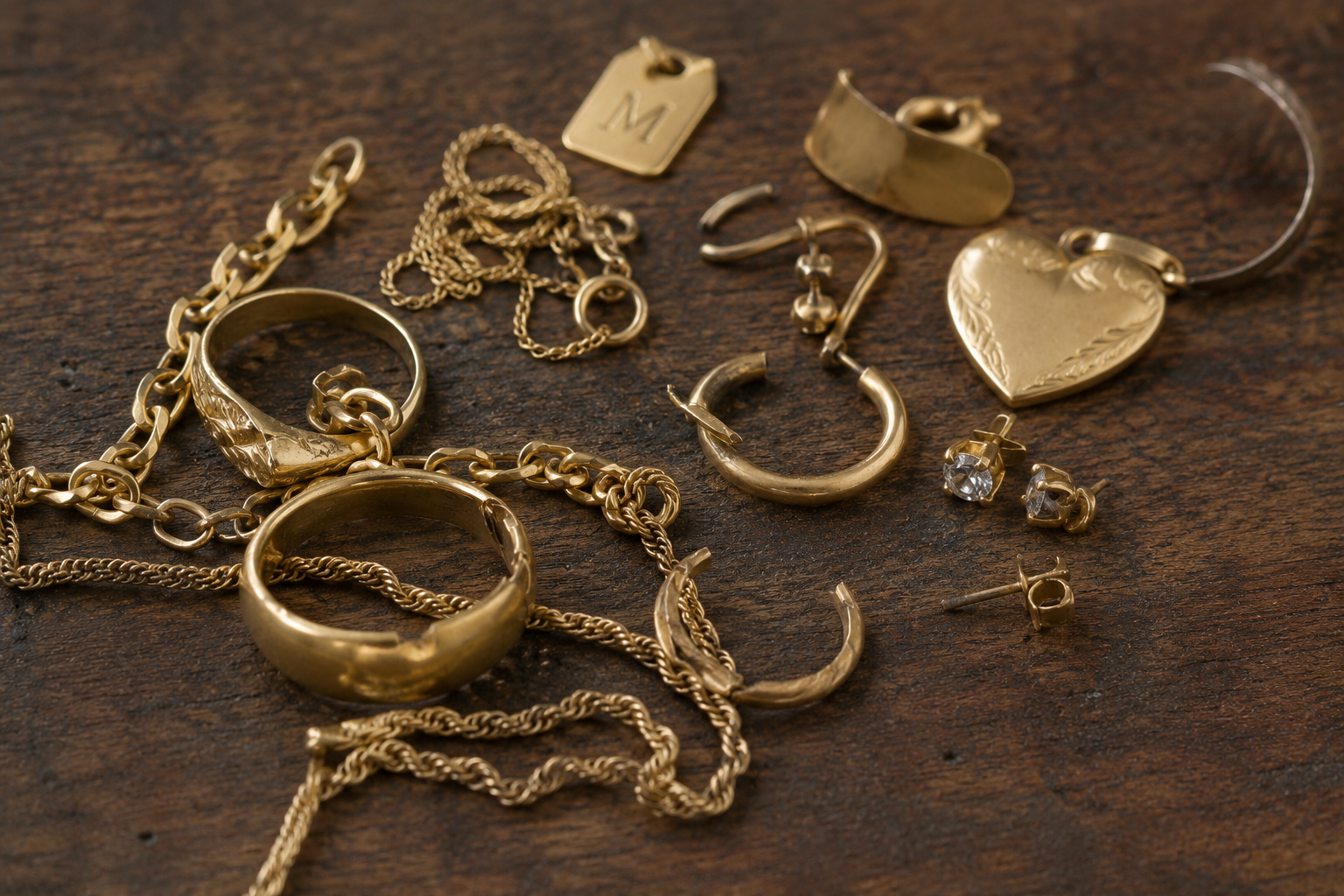
A broken chain at the bottom of a jewelry box. A single earring that lost its match years ago. A ring that no longer fits or a bracelet that simply isn’t your style anymore.
It can be easy to look at old or damaged gold jewelry and assume it has lost its value. But when it comes to old gold jewelry, appearance and wearability aren’t the only things that matter. The gold itself may still hold value—even when the jewelry is broken, bent, outdated, or incomplete.
Before tossing an old piece aside, it may be worth taking a closer look at what you actually have.
Broken Doesn’t Necessarily Mean Worthless
Jewelry is meant to be worn, so damage happens. Clasps break, chains snap, rings bend, stones fall out, and earrings lose their matches.
While damage can affect the resale potential of a finished piece, it doesn’t automatically eliminate the value of the gold it contains. Gold is a precious metal that can be recovered and recycled, meaning a piece doesn’t necessarily need to be wearable to have value.
In fact, the World Gold Council notes that gold is virtually indestructible and that nearly all the gold ever mined theoretically remains available in some form for recycling. Jewelry accounts for the vast majority of recycled gold entering the market.
So that tangled necklace or damaged ring you’ve been holding onto? It may deserve another look.
What Kinds of Old Gold Could Still Have Value?
You don’t need a perfectly preserved piece of fine jewelry to consider having your gold evaluated.
Examples can include:
- Broken necklaces and chains
- Bent or damaged rings
- Single or mismatched earrings
- Broken bracelets
- Old pendants and charms
- Jewelry with missing stones
- Outdated gold jewelry
- Unwanted wedding bands
- Inherited pieces you don’t wear
- Gold jewelry that’s been sitting unused for years
Even pieces that don’t seem useful anymore may contain gold that contributes to their value.
Before assuming something isn’t worth bringing in, let an experienced professional take a look.
What Determines the Value of Old Gold?
The original retail price isn’t necessarily the most important number when evaluating old gold. Several factors can contribute to what a piece is worth today.
Gold Purity
You’ve probably seen markings such as 10K, 14K, or 18K on jewelry. These karat marks indicate how much pure gold is contained in the metal.
Generally, the higher the karat, the greater the percentage of gold. For example, 14K gold contains about 58.3% gold, while 18K contains 75%.
If you’d like to understand those markings better, read our guide to what 10K, 14K, and 18K gold karat marks mean.
Weight
The amount of gold in a piece also matters.
Two necklaces could both be marked 14K but have very different values if one contains considerably more gold than the other. That’s why weight and purity are often considered together when evaluating gold jewelry.
Current Gold Market
Gold doesn’t have one permanent price. Its market value changes over time based on global supply, demand, investment activity, economic conditions, and other factors.
This means the value of gold sitting in your jewelry box today may not be the same as it was several years ago.
According to the World Gold Council’s latest data, higher gold prices have encouraged more consumers to sell old jewelry, with recycled gold supply increasing during the first quarter of 2026.
You can follow current market developments through the World Gold Council’s Goldhub.
The Piece Itself
Gold content isn’t always the entire story.
Depending on the jewelry, factors such as the maker, brand, craftsmanship, gemstones, condition, design, and resale demand may also influence its overall value.
That’s one reason an evaluation can be more useful than simply weighing a piece at home.
What If You Can’t Find a Karat Mark?
Don’t immediately assume an unmarked piece isn’t gold.
Karat markings can sometimes be extremely small, worn down with age, hidden near a clasp, or difficult to read. Older and inherited jewelry can be especially tricky when you don’t know its history.
Professionals have several methods for assessing gold purity. The Gemological Institute of America (GIA), for example, describes touchstone testing as one established method for determining the purity of karat gold.
Instead of relying solely on a stamp—or trying potentially damaging DIY tests—consider having the piece professionally evaluated.
Outdated Style Doesn’t Mean Outdated Value
Maybe nothing is technically wrong with your jewelry. You just haven’t worn it since styles changed.
A chunky gold bracelet, an old-fashioned ring, or a necklace that no longer matches your taste can spend years sitting untouched simply because you don’t see yourself wearing it again.
But style and material value are two different things.
Gold doesn’t suddenly stop being gold because the design isn’t currently fashionable. An outdated piece could potentially be sold, pawned, repaired, or even transformed into something new.
American Jewelry and Loan also offers custom jewelry services for customers interested in exploring options for jewelry they already own.
Sometimes an old piece doesn’t need to disappear—it just needs a new purpose.
Learn more about our custom jewelry service.
Sell It, Pawn It, or Give It Another Life
Once you know your old gold may have value, the next question is what you want to do with it.
If you’re ready to part with jewelry you no longer use, selling it for cash may make sense. American Jewelry and Loan can evaluate your item and make an offer based on its current value.
If you still want to keep the piece, pawning gives you another option. You can use the item’s value to access cash while retaining the opportunity to reclaim your jewelry later.
And if the piece has sentimental value but no longer fits your style, repair or custom jewelry services may offer another path.
The right choice depends on the jewelry and what you want from it.
Learn more about selling your item.
Old Gold Is Also Part of a Bigger Cycle
Gold is different from many everyday materials because its usefulness doesn’t necessarily end when a piece of jewelry becomes damaged, outdated, or unwanted.
A broken necklace may no longer work as a necklace, and an old ring may no longer suit your style, but the gold within those pieces can potentially be recovered, reused, and given a completely different purpose. It could eventually become part of another piece of jewelry or be repurposed in another form.
That’s why old gold doesn’t have to spend years forgotten at the bottom of a jewelry box. Even pieces that are scratched, bent, broken, incomplete, or simply no longer worn may still have something to offer.
The jewelry may have reached the end of its story with you, but the gold itself may still have another chapter ahead.
Before You Forget About That Old Gold…
Take another look through your jewelry box.
That broken bracelet, outdated ring, tangled chain, or lone earring might not look like much anymore—but its appearance doesn’t necessarily tell you what it’s worth.
At American Jewelry and Loan, our experienced team can evaluate your gold and help you understand your options. Whether you’re interested in selling, pawning, or exploring a new purpose for an existing piece, it starts with finding out what you actually have.
Don’t let old gold collect dust just because you don’t wear it anymore.
Learn more about selling your items or visit your nearest American Jewelry and Loan location for an evaluation.